A cottage sauna in Canada is usually wood-fired, because many cottages have no power or no spare 240 V circuit, and a wood stove needs none. The catch is paperwork: no wood sauna stove sold in Canada carries a Canadian safety listing, so the stove is installed to the CSA B365 code with larger clearances, most insurers ask for a WETT inspection (APC in Quebec), and some townships and fire rules add their own conditions. If the cottage has good power and you're there year-round, an electric heater is simpler.
This guide covers choosing wood or electric at the cottage, the stove, chimney and clearances, insurance and WETT, fire bans, closing the sauna for winter, and the lake dip that makes a cottage sauna what it is, with a cold plunge for when the lake is frozen or too far.
Wood or electric at the cottage
- No power, or only a small service: wood. A traditional electric heater needs its own 240 V circuit: Harvia's 6 kW KIP draws 25 A (Harvia KIP manual). Running that from a generator or solar system means a large, continuous load; ask an electrician before you plan on it.
- Good power and weekend visits: electric heats on a timer or app, with no firewood, chimney sweeping or insurer questionnaire.
- Want the fire: wood, and accept the permit, inspection and insurance steps.
The full comparison, with running costs, is in wood vs electric sauna.
The stove: no Canadian listing, so plan the install
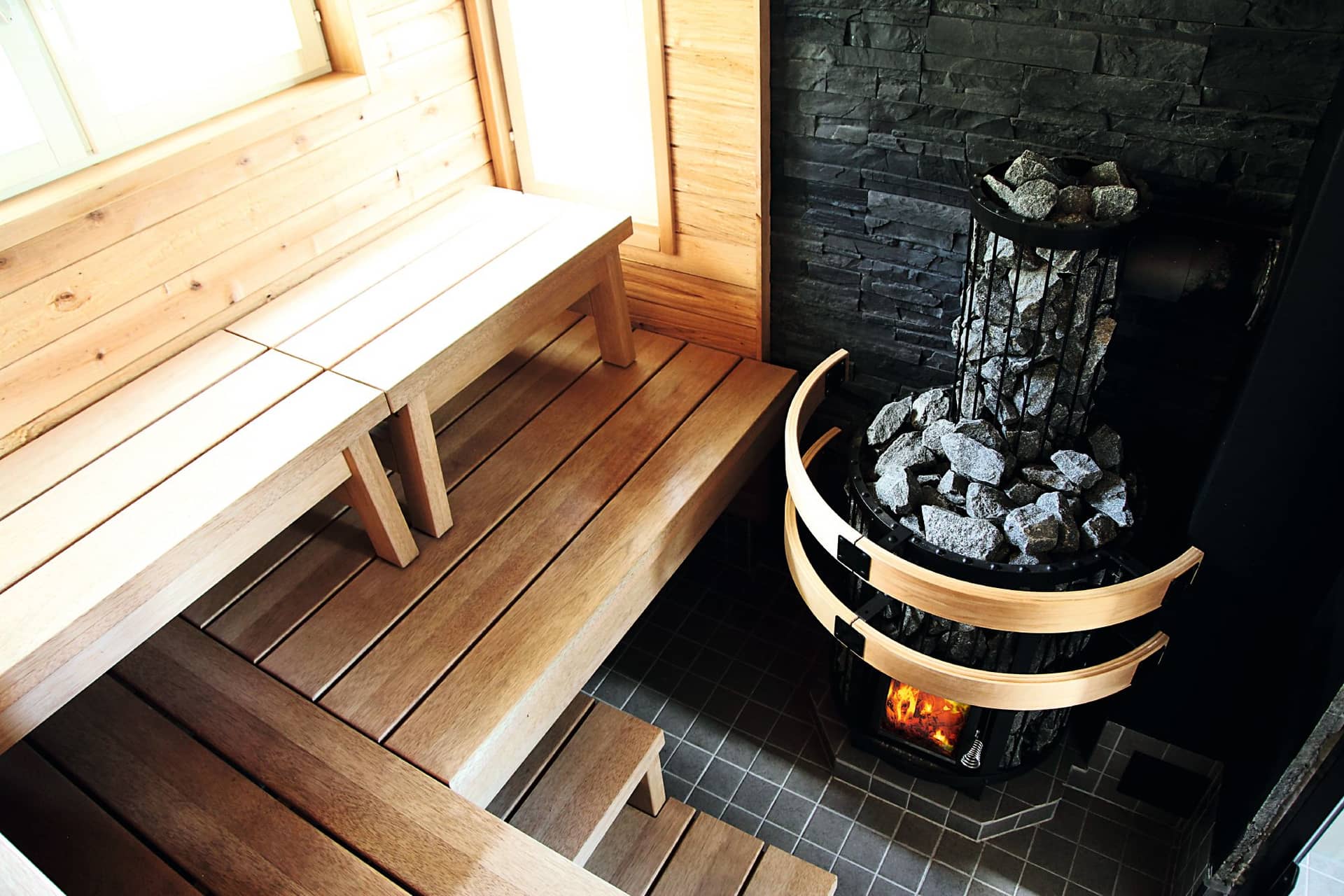
We checked the wood sauna stoves on the Canadian market and found none with a Canadian safety listing (cUL/ULC, CSA or cETL). Henki, an Ontario stove maker, states the same. The Harvia Legend 150 we sell carries European marks (CE to EN 15821), not Canadian ones.
What that means in practice:
- Install to CSA B365, the national installation code for solid-fuel appliances indoors or outdoors (CSA B365). For an appliance without a listing, the code sets larger clearances to combustibles than a listed stove would get.
- Follow the stove's own figures as a minimum. Harvia's manual for the Legend 150 asks for 1,000 mm (39⅜ in) above, 200 mm (7⅞ in) at the sides, 250 mm (9 13/16 in) behind and 500 mm (19 11/16 in) in front to combustible materials, a T600-class chimney on its 115 mm collar, and floor protection unless it stands on plain concrete at least 60 mm thick.
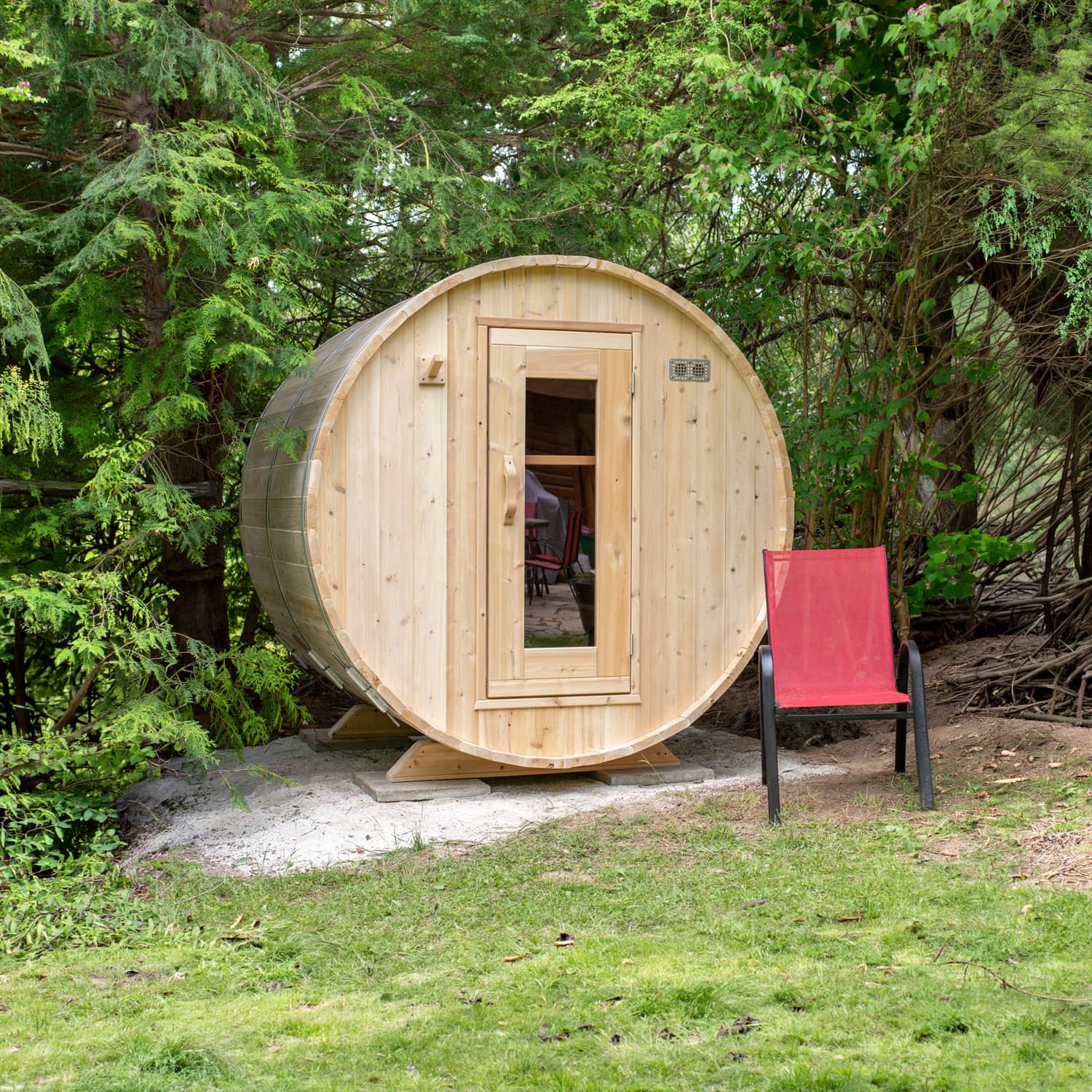
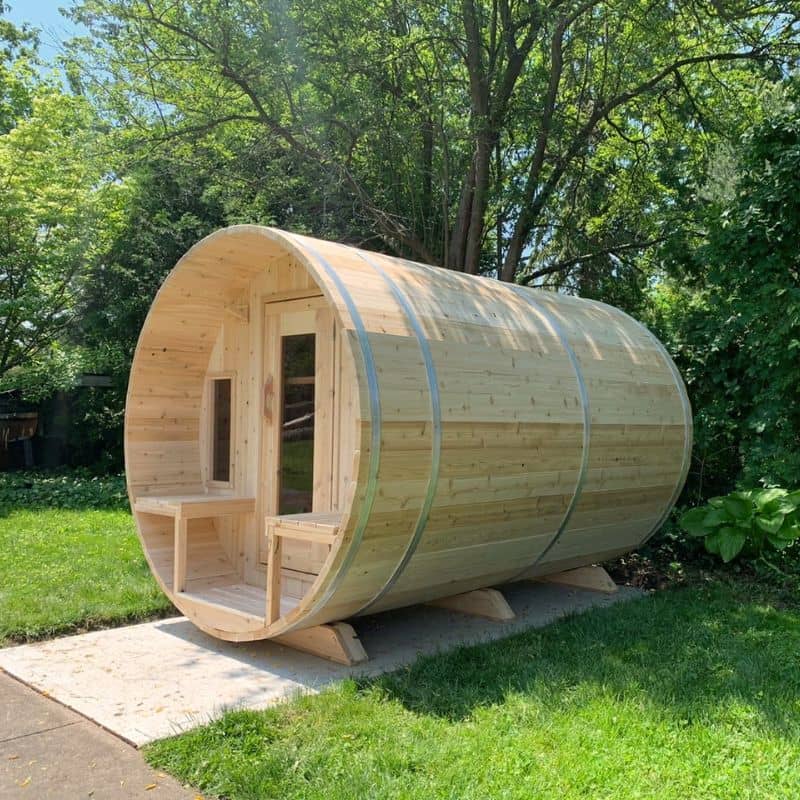
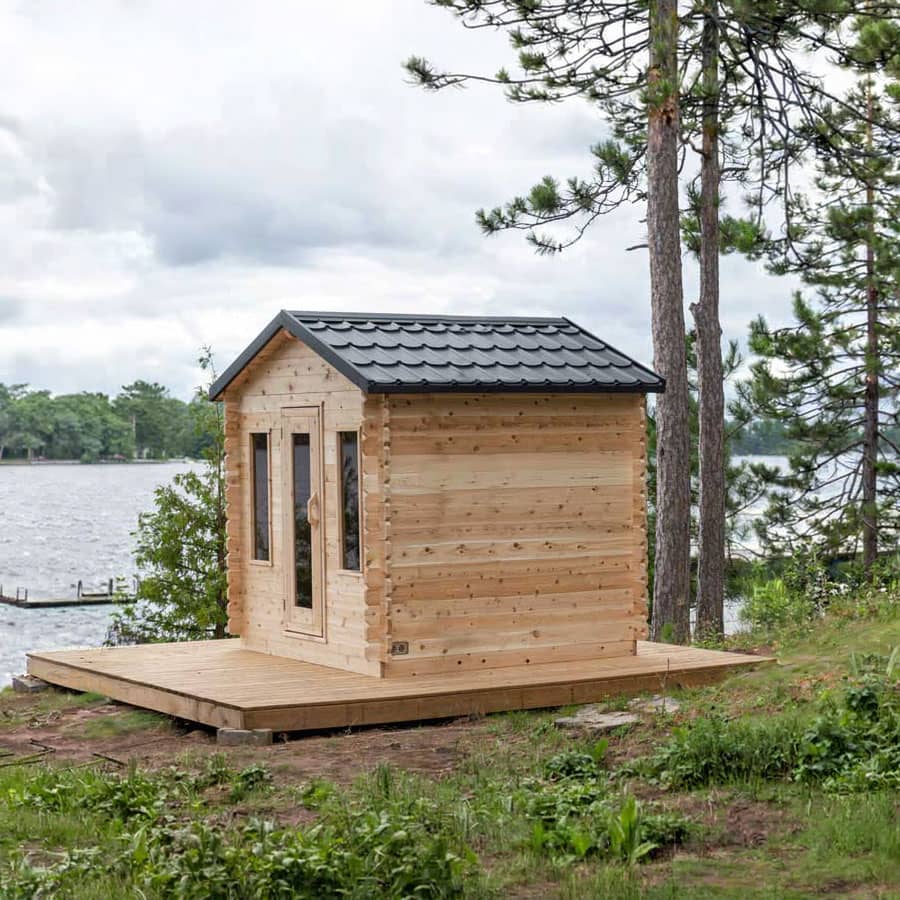
- Size it to the room. The Legend 150 is a 16 kW stove for rooms of 6–13 m³. The Harmony (6.3 m³), Tranquility (8.4 m³) and Georgian cabin (9.7 m³) fall in that range; the MiniPOD takes a wood stove only in its side-bench layout. The Pure Cube is electric only.
- Ask first. Before you order, ask your township's building department and your insurer, in writing and with the stove model, whether they will accept an unlisted sauna stove. Some towns restrict uncertified stoves for air quality.
Browse every heater, wood and electric, in sauna heaters.
Chimney, clearances and sparks
- Chimney height. The National Building Code's rule is at least 900 mm (36 in) above the highest point where the chimney meets the roof, and 600 mm (24 in) higher than any roof surface within 3 m (NRC illustrated guide to Part 9). Factory-built chimneys are installed to their own listing.
- Chimney standard. Alberta's guide says factory-built chimneys for wood appliances must meet CAN/ULC-S629 and be installed to CSA B365 (Alberta). Insurers may ask for the ULC-S629 label.
- Spark arrestor. FireSmart Canada calls for an approved spark arrestor of 12-gauge mesh with openings under 12 mm, and 3 m between the chimney outlet and trees (FireSmart); Quebec's SOPFEU says mesh no larger than 1 cm × 1 cm (SOPFEU). On a wooded lot this is the single most useful part you can add.
- Around the sauna. Keep firewood, dry leaves and the woodpile away from the stove wall and chimney. A slab or pavers in front of the door gives you a non-combustible step; see sauna foundation.
Insurance and WETT
Tell your insurer before you install a wood stove at the cottage. The Insurance Bureau of Canada says wood-burning appliances affect the availability and affordability of home insurance (IBC), and not disclosing one can lead to a denied claim (BrokerLink).
- WETT inspection. A WETT-certified inspector (an individual, not a company) checks the installation; a Level 1 inspection is the one used for most insurance needs (WETT Inc.). You get a written report, not a "WETT certificate" (WETT FAQ). In Quebec, ask for an APC-certified inspector.
- Cottage insurers vary. The Federation of Ontario Cottagers' Associations notes that insurers differ: some send a questionnaire, others ask for a WETT inspection. It also advises cleaning the chimney at least once a year and keeping a Class A extinguisher (FOCA).
- Outbuildings. Intact describes outbuildings such as boathouses and sheds as optional coverage on cottage policies (Intact). Make sure the sauna building is listed, not just the stove.
- Leisurecraft's advice for its saunas is the same: get a WETT inspection (Leisurecraft).
Fire bans and wildfire season
Cottage country has wildfire rules that town lots don't.
- British Columbia. During a campfire ban, wood-fired devices are prohibited unless vented through a flue that is part of a building (BC Wildfire Service). An exempt "outdoor stove" must be certified and burn gas, liquid or charcoal, so a wood stove doesn't qualify (BC open burning).
- Alberta. In the Forest Protection Area, an indoor wood fire inside a structure, in a device with a chimney and spark arrestor, stays allowed during a fire ban (Alberta fire bans). Towns can set their own bans.
- Ontario. The outdoor fire rules set conditions for wood stoves used outdoors, including distance from flammables and working spark arresters on vents and chimneys (O. Reg. 43/26). Whether a stove inside a sauna counts as an outdoor fire isn't spelled out; ask your township or the local fire department.
Check the fire-danger rating before you light the stove in a dry summer, and never leave a fire burning when you leave the cottage.
Closing the sauna for winter
- Drain anything that holds water. Harvia's wood-stove manual says to empty the water container if the stove won't be used for a while or the water may freeze, and to leave the tap open (Harvia Pro 20 manual). Never drain it while hot.
- Don't leave water standing in buckets, ladles or on the floor; Leisurecraft's maintenance guide says not to leave standing water to freeze inside (Leisurecraft).
- Snow. Clear snow from the door, vents and chimney before you light it in winter, and expect a longer warm-up: Leisurecraft says 15–20 minutes longer in deep winter (Leisurecraft).
- Electric heaters in an unheated sauna. Harvia says the overheat cut-out on some mechanical-timer heaters can trip below about −5 °C, and resetting it needs the room warmed up first (Harvia support). Check your heater's manual if it will sit in a frozen cottage.
- Leave the door and vents ajar after the last session so the wood dries, and sweep the chimney before the next season.
The lake dip, safely
The jump in the lake is half of a cottage sauna. Cold water is also where it can go wrong.
- Cold shock first. The Lifesaving Society's 1-10-1 rule: about 1 minute to get your breathing under control, about 10 minutes of useful movement, and up to an hour before hypothermia makes you unconscious (Lifesaving Society). Public Health Ontario notes cold shock can happen even in water of 10–15 °C (PHO). Transport Canada reports that about 94% of Canadian boaters who drown were in water under 20 °C (Transport Canada).
- Enter by a ladder or steps, never dive into cold or unfamiliar water, and never dip alone or after alcohol.
- Ice holes. The Canadian Red Cross gives 15 cm of clear blue ice as the minimum for walking alone and 20 cm for groups; white ice is about half as strong (Canadian Red Cross). Ice near docks, inflows and springs is weaker.
- Health. Heart & Stroke warns that sudden cold can spike blood pressure, a risk with heart disease; check with your doctor first (Heart & Stroke).
A cold plunge when the lake is frozen or far
If the water is a long walk away, or iced over for months, a tub by the sauna gives you the cold without the hike.
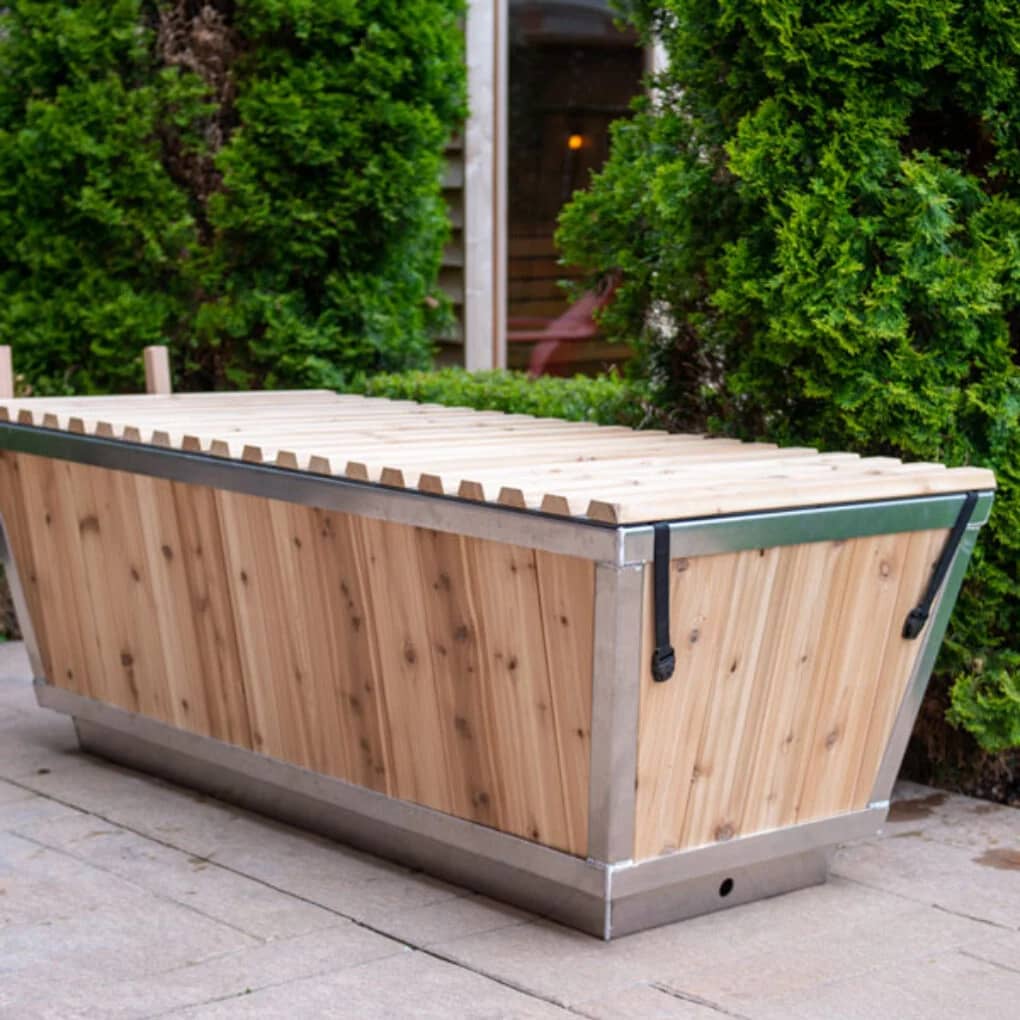
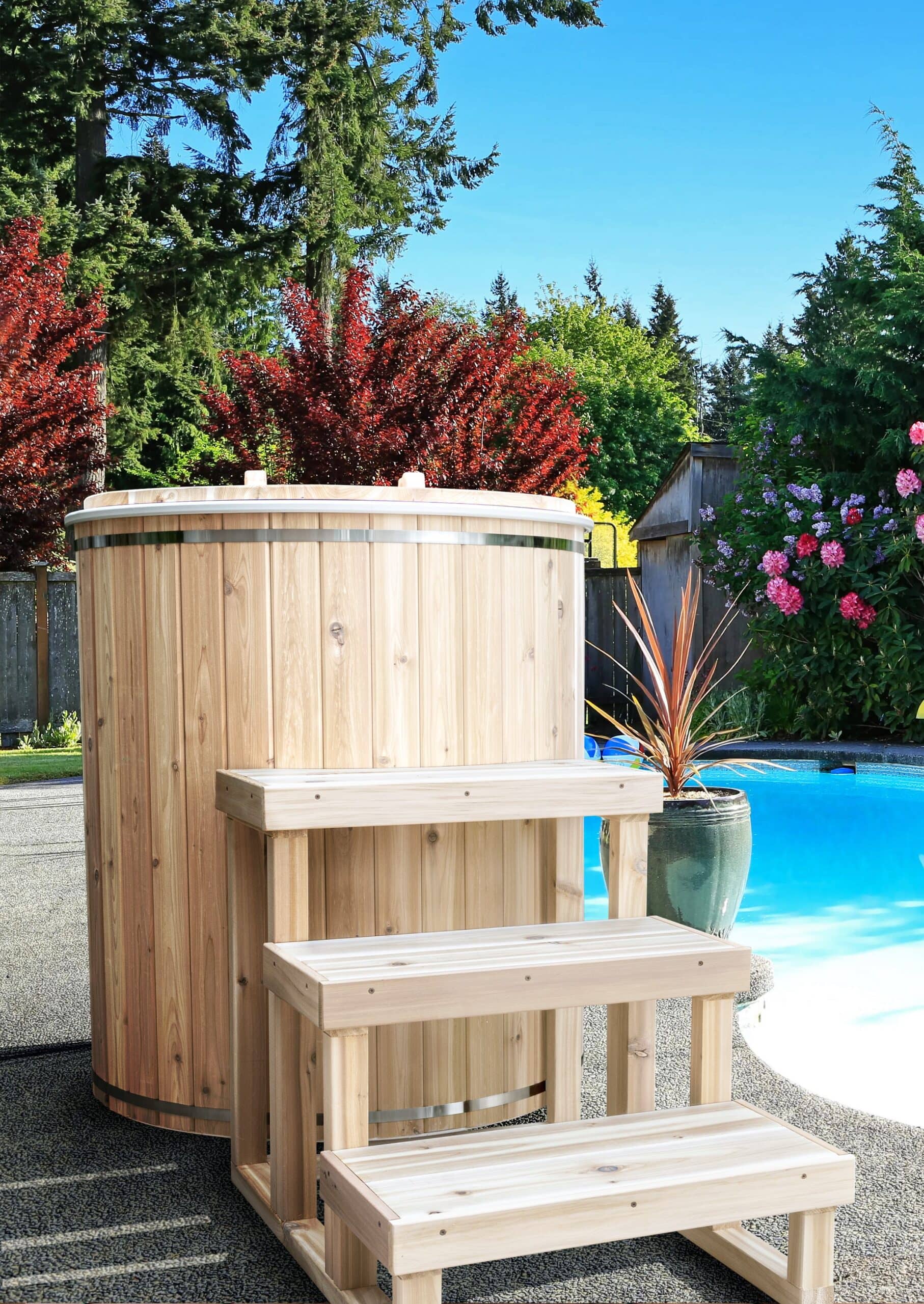
- No power needed: the Leisurecraft Polar Plunge cedar tub holds about 720 L and drains to a garden hose; the Baltic cedar plunge barrel holds about 501 L and ships fully assembled. Fill them with cold water, or lake water and ice. Both have no built-in cooling.
- With power: the Coldture PRO Water Chiller runs on 120 V and can be used outdoors in a sheltered spot down to −10 °C ambient (Coldture).
- Freezing nights. Leisurecraft says that at 0 °C or colder you should drain the chiller and store it somewhere heated, or keep it running at a warm setting so it doesn't freeze.
Compare all four in our cold plunges and the cold plunge buying guide.
Water from the sauna and the septic
A sauna with a shower or a floor drain makes greywater. In Ontario, greywater must go to an approved sewage system: the Building Code has a Class 2 greywater system (a leaching pit, up to 1,000 L a day) (OBC 8.4), and health units such as Thunder Bay's list sauna water among what a leaching pit takes, with inspection and approval (TBDHU). Don't drain sauna or shower water toward the lake. Ask your health unit or conservation authority before you build near the shore, and see our permits guide.
Lake dip or cold plunge at the cottage
Scroll the table sideways to see every column.
| Option | Power | Winter | Notes |
|---|---|---|---|
| The lake | None | Ice hole only on 15 cm+ clear ice | Ladder in, never alone; cold shock risk |
| Polar Plunge cedar tub, about 720 L | None (chiller optional) | Drain, or keep a chiller running warm | Hose drain included |
| Baltic cedar plunge barrel, about 501 L | None (chiller optional) | Drain, or keep a chiller running warm | Ships fully assembled |
| Coldture PRO Water Chiller | 120 V, 8 A | Sheltered, down to −10 °C ambient | Pairs with a tub; 3–40 °C |
Questions
What is the best sauna for a cottage?
One that suits your power. With no 240 V service, a wood-fired barrel or cabin, such as the Harmony, Tranquility or Georgian, sized to a stove's room range. With good power and weekend visits, an electric heater is simpler. Either way, plan the base, the permit and insurance first.
Can you have a sauna at a cottage with no electricity?
Yes, with a wood stove, which needs no power. Plan the chimney, clearances and spark arrestor, install to CSA B365, and get a WETT inspection for your insurer.
Are wood sauna stoves certified in Canada?
We found none with a Canadian listing (cUL/ULC, CSA or cETL); Henki, an Ontario stove maker, says the same. Unlisted stoves are installed to CSA B365 with larger clearances, and you should ask your township and insurer in writing before you buy.
Does my cottage insurance cover a wood-burning sauna?
Only if you tell your insurer and they accept it. Many ask for a WETT inspection report (APC in Quebec) or a questionnaire, and some may charge more or decline. Make sure the sauna building is listed on the policy.
Can I use my sauna during a fire ban?
It depends on the province. BC and Alberta allow wood fires in a device vented through a building's chimney in some cases; Ontario's rules don't spell out saunas. Check with your township or fire department, and don't light up in extreme fire danger.
How do I winterize a cottage sauna?
Drain the stove's water container and any water lines, leave no standing water, sweep the chimney, leave the door and vents ajar to dry, and check whether your electric heater's cut-out trips in deep cold.
Is it safe to jump in the lake after a sauna?
It can be if you plan for cold shock: enter by a ladder, never alone or after alcohol, and know the 1-10-1 rule. In winter, use only clear ice of at least 15 cm, per the Red Cross. Ask your doctor first if you have a heart condition.
Do I need a permit for a cottage sauna?
Often for the wood stove, and sometimes for the building and shoreline setbacks. See our permits guide, and ask your township and conservation authority before you choose a spot.
Sources
Checked November 2026.
- Stoves: Henki, certified sauna stoves in Canada; CSA B365:25; Leisurecraft, wood-burning sauna stoves; Harvia Legend 150 manual (linked on the product page)
- Insurance: WETT Inc., about WETT inspections and FAQ; Insurance Bureau of Canada; FOCA cottage insurance tips; BrokerLink; Intact cottage insurance
- Chimneys and sparks: NRC, illustrated user's guide to NBC Part 9; Alberta, solid-fuel burning appliances; FireSmart Canada; SOPFEU
- Fire rules: Ontario O. Reg. 43/26; BC open burning and BC Wildfire Service; Alberta fire bans
- Winter: Harvia Pro 20 manual; Harvia, heaters in cold conditions; Leisurecraft maintenance guide; Leisurecraft outdoor sauna guide; Harvia KIP manual
- Water safety: Lifesaving Society; Canadian Red Cross; Transport Canada Safe Boating Guide; Public Health Ontario; Heart & Stroke
- Plunges: Coldture PRO Water Chiller; Leisurecraft plunge specs on each product page
- Septic: Ontario Building Code 8.4; Thunder Bay District Health Unit