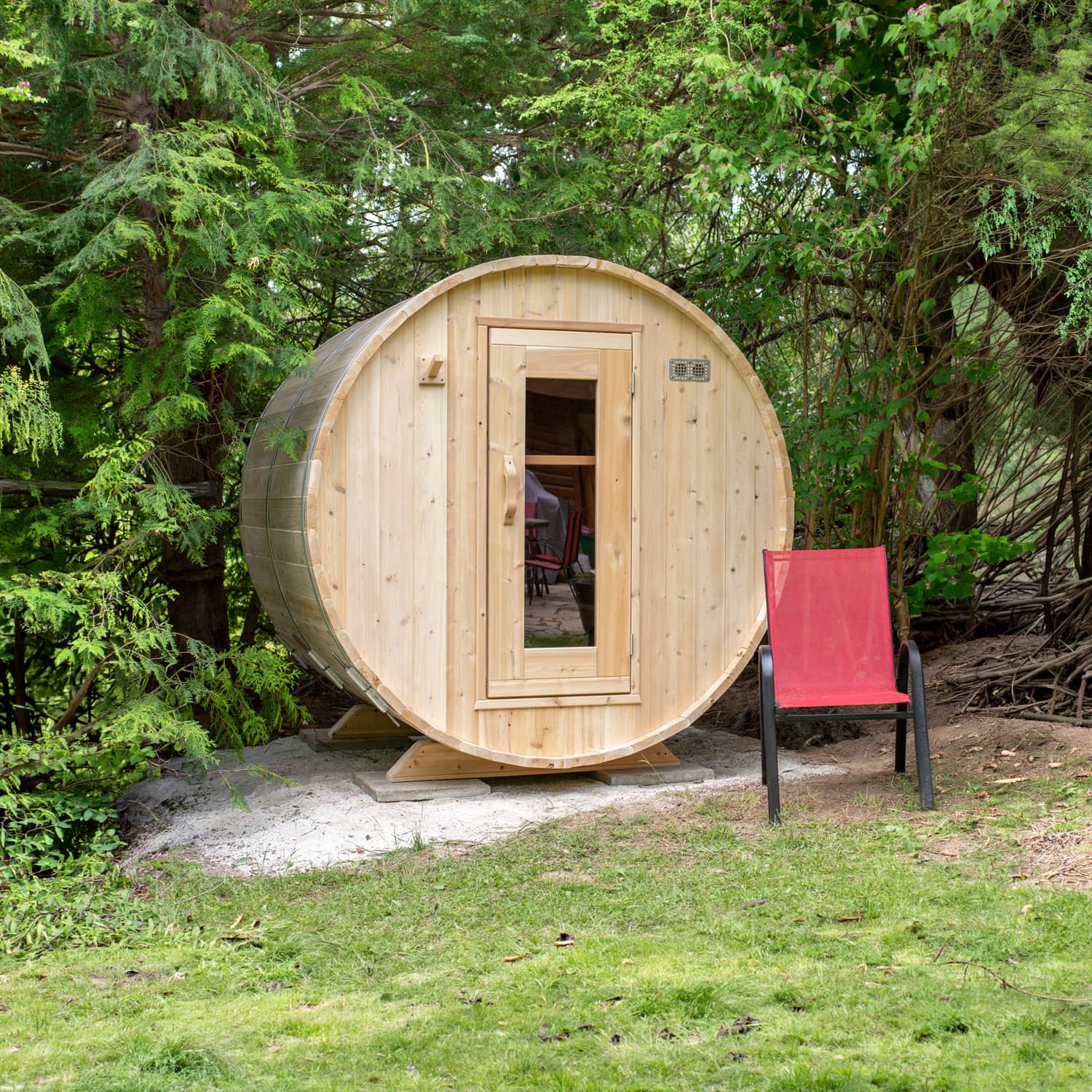
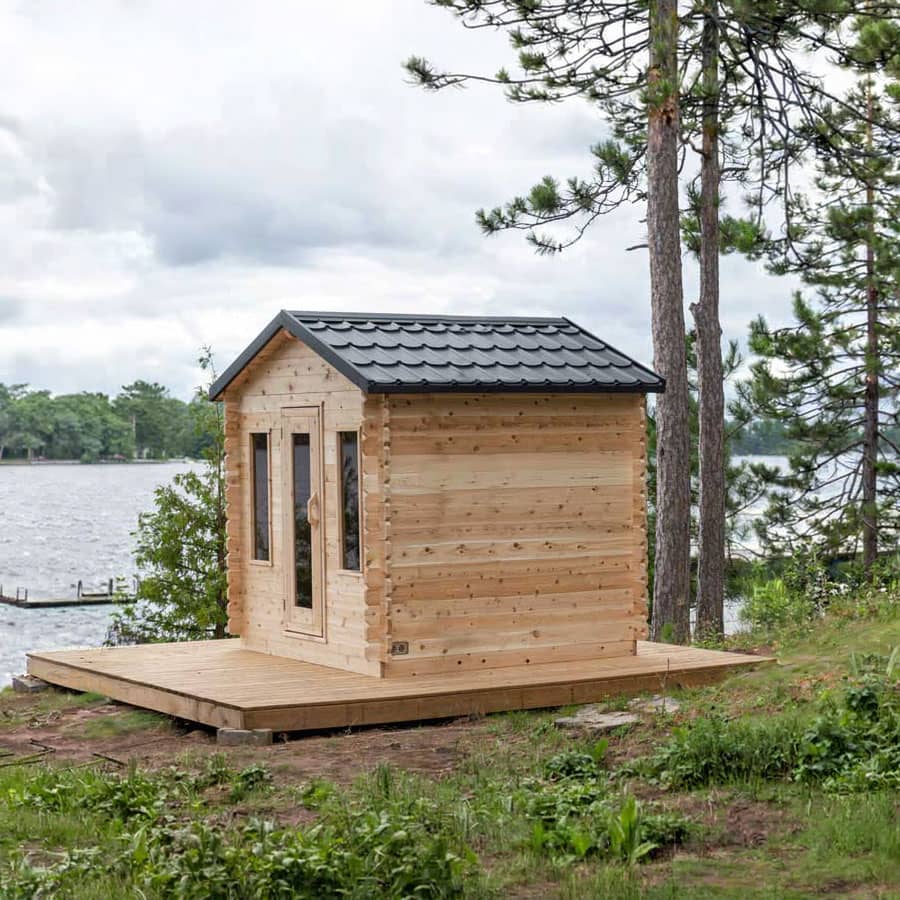
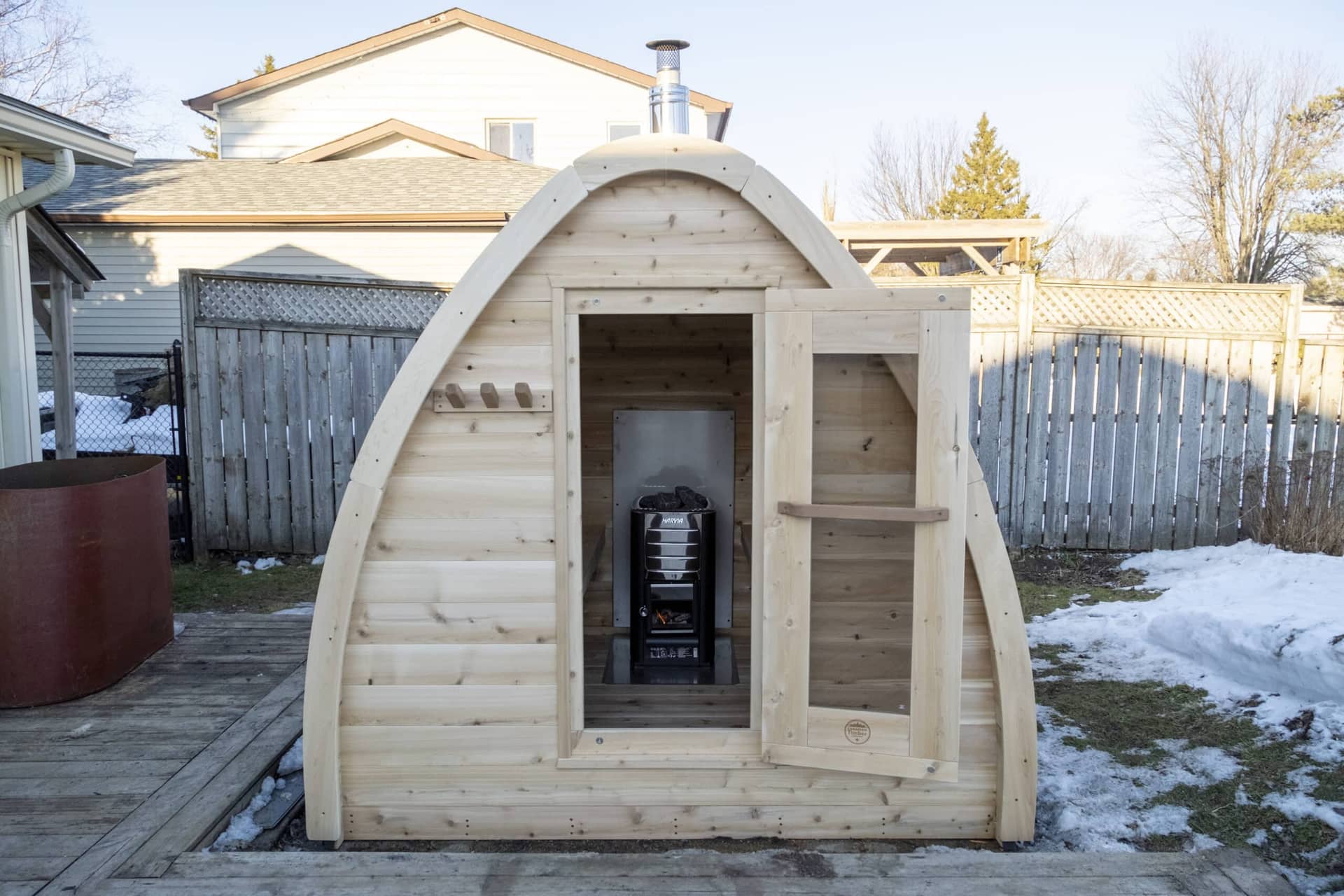
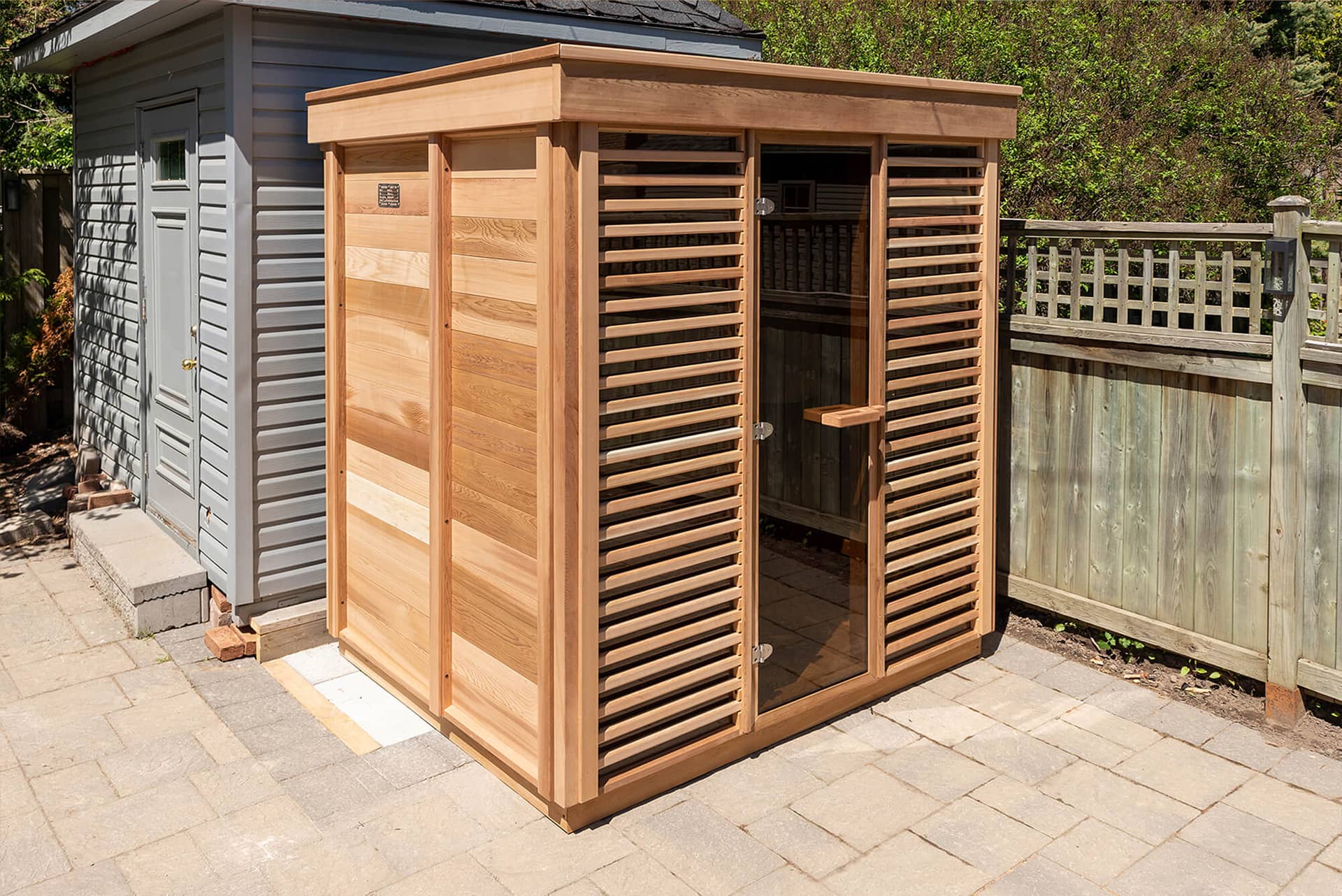
Usually yes, for at least one part of the job. A small outdoor sauna often needs no building permit: Toronto exempts storage sheds under 15 m² and Calgary, Edmonton, Vancouver and Winnipeg draw the line at 10 m². But every city still applies its zoning rules (setbacks, height, lot coverage), an electric heater needs an electrical permit or notification in every province we checked, and a wood stove often brings a building permit and an insurer's inspection of its own.
The saunas we sell cover 3.9 to 6.6 m² (41 to 71 sq ft), and 9.3 m² for the Georgian cabin with its changeroom. That puts most of them under the common 10 m² line, but a sauna is not a storage shed, and some cities treat it differently. This guide sets out the rules city by city and province by province, with the official page for each, so you can ask your municipality the right questions before you order. Rules change and differ by zone: treat this as a starting point and get your city's answer in writing.
The three permits a sauna can need
Think of a backyard sauna as three separate questions, each answered by a different office:
- The building itself. Your municipality's building department decides whether the structure needs a building permit. Most exempt small accessory buildings, but the size limit and the conditions vary: in Ontario the code exemption is written for storage sheds, while Alberta and BC cities use 10 m².
- Where it sits. Zoning applies whether or not you need a building permit. Toronto says it plainly: "Even if a building permit is not required, compliance with the Zoning Bylaw is required" (City of Toronto). Setbacks from the lot lines, height and lot coverage are zoning questions.
- What heats it. An electric heater needs a dedicated circuit (240 V for almost every heater), and new wiring needs a permit or notification from the provincial or city electrical authority. A wood stove is a solid-fuel appliance: many municipalities want a building permit for it, and most insurers want an inspection.
So even when the building is exempt, plan on at least one permit or notification for the heat source. We don't know of a Canadian city where a heated sauna needs no paperwork at all.
How big is your sauna, in permit terms?
Permit rules are written in floor area (the footprint), and sometimes height. Here are the numbers for the saunas we sell, worked out from the manufacturers' exterior dimensions. Bring them, and the product page, when you call your municipality.
The footprint table on this page lists each model. Porch and changeroom versions add to the footprint, which is why the Georgian cabin with a changeroom (about 9.3 m², 99 sq ft) sits just under the 10 m² line used in Calgary, Edmonton, Vancouver and Winnipeg.
Height matters too. The barrels stand 214–219 cm (7 ft–7 ft 2 in), the Pure Cube 231 cm and the Georgian 256 cm (8 ft 5 in). Edmonton, for example, lets a shed sit right on the rear lot line only if its roof peak is no higher than 2.4 m; every outdoor model we sell except the Georgian (256 cm) comes in under that.
Two cautions. A deck, pad or roof extension you build around the sauna may count toward the area. And the exemption is usually for one small building, not unlimited sheds: check whether your city adds up all accessory buildings on the lot.
City by city: the building-permit line
What each city's own page says, checked in November 2026. In every case, zoning rules still apply below the line.
Toronto
A building permit isn't needed for a shed that is "not more than 15 m2 in gross area", one storey, not attached to anything, used only for storage and without plumbing. The same page says an accessory structure larger than 10 m² (107 sq ft) needs a permit, and any accessory structure with plumbing needs one regardless of size. Installing a wood-burning stove or fireplace is on Toronto's list of work that needs a building permit (City of Toronto). Because a sauna is not a storage shed, ask Toronto Building whether yours falls under the 10 m² rule; all of our models are under 10 m² without a changeroom.
Ottawa
Ottawa's garage-and-shed page asks for a permit for accessory buildings over 10 m² (108 sq ft), with a separate 15 m² exemption for a one-storey storage shed without plumbing (City of Ottawa). A December 2025 Building Code Services advisory widened that exemption to some other small accessory structures in low-rise residential settings, with conditions, and says the city can assess any structure case by case (advisory). Read it, then confirm with Ottawa before you build.
Calgary
"Accessory residential buildings under 10 m² (107 sq. ft.) in area typically do not require a building permit," but they must follow the Land Use Bylaw. Calgary's general height cap for these buildings is 4.6 m (15 ft), and the 0.6 m (1.9 ft) setback from rear and side lines is relaxed for buildings under 10 m². New wiring needs a separate electrical permit (City of Calgary).
Edmonton
No permit when the accessory building is under 10 m², not attached to a house or other building, and not connected to electricity, plumbing or gas. A shed can sit 0.6 m from the rear property line, or closer if its roof peak is no higher than 2.4 m (City of Edmonton; Zoning Bylaw 7.120). Note the power condition: an electric sauna is connected to electricity, so expect permits.
Vancouver
The Vancouver Building By-law exempts accessory buildings "less than 10 m2" that don't create a hazard (VBBL text). Vancouver also issues its own electrical permits. Zoning and siting rules still apply.
Montréal
Rules are set borough by borough. Many boroughs require a permit once an outbuilding is larger than 15 m²; Rosemont–La Petite-Patrie uses 12 m² and allows one shed, Outremont 14 m², and some boroughs require authorization at any size. Height limits range from 3 to 4 m, and rear setbacks of about 0.6 m are common (Ville de Montréal). Wood stoves have their own city-wide rules (see below).
Winnipeg
Detached garages and accessory structures "greater than 10 m2 (108 sq. ft.)" need a building permit, and electrical or plumbing work needs trade permits (City of Winnipeg). Below that size, the structure must still meet the zoning by-law and the building code.
Halifax
We could not find a current Halifax (HRM) page that sets a no-permit size for small accessory buildings. HRM's fee schedule lists a development-permit fee for sheds and accessory buildings (HRM permit fees), so contact HRM Planning & Development (311) before you build, even for a small sauna.
Province by province: the baseline
Cities apply provincial codes, and the provincial rule explains most of what you see above.
- Ontario. The Building Code exempts certain storage sheds of 15 m² or less (Ontario lists the shed exemption among its Building Code updates). Cities read that exemption narrowly or widely, as Toronto and Ottawa show. Electrical work goes to the Electrical Safety Authority as a notification, including a homeowner working on their own house.
- Alberta. Calgary and Edmonton use 10 m² and issue their own building and electrical permits. Calgary listed a homeowner electrical permit at $112 plus a 4% safety codes fee (City of Calgary trades permits); Edmonton allows homeowner electrical permits only for owner-occupiers of detached homes (City of Edmonton).
- British Columbia. Building permits are municipal; 10 m² is the common line in the Lower Mainland. Technical Safety BC issues electrical permits in most of the province, but Vancouver, Burnaby, Surrey, Victoria and a few others issue their own. Homeowner electrical permits have limits (TSBC homeowner permits).
- Quebec. Municipalities and boroughs set building permits. Electrical work must be done by a licensed contractor, even in your own home (RBQ).
- Manitoba. Winnipeg issues its own building and electrical permits; elsewhere, Manitoba Hydro handles electrical permits.
- Saskatchewan. TSASK says a permit is needed for all electrical work at home.
- Nova Scotia and the other Atlantic provinces. We haven't confirmed a provincial baseline yet. Call your municipality and the provincial electrical inspection office before work starts.
Electric heaters: permits and the one-hour timer
Every traditional electric heater we sell runs on a dedicated 240 V circuit, and every province we checked requires a permit, notification or declaration for that new wiring. Our sauna electrical requirements guide has the breaker and wire sizes by heater.
In Ontario, the ESA's notice on sauna heater fires sums up the code: the heater must be marked as suitable for a sauna, installed with its nameplate clearances, and controlled by a timer that switches it off after no more than one hour (ESA Flash 25-20-FL). An inspector will look for that.
An outdoor sauna also needs a buried or overhead feed from the house. The length of that run changes the wire size and the cost, so get the electrician's quote before you settle on a spot. If the site has no power at all, see our cottage sauna guide.
Wood stoves: permits, CSA B365 and WETT
Wood heat is where the paperwork grows.
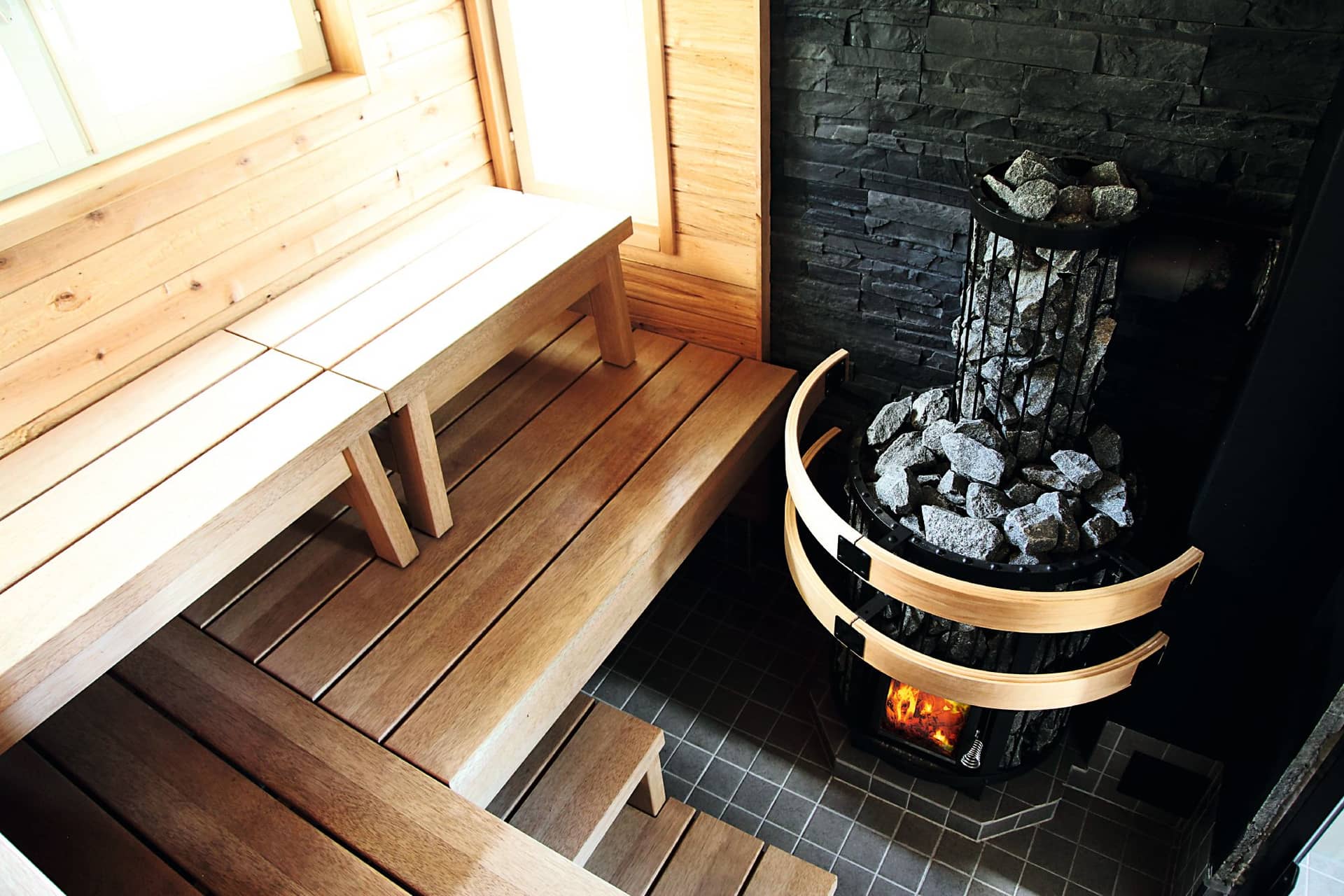
- No wood sauna stove sold in Canada carries a Canadian safety listing (cUL/ULC, CSA or cETL). Henki, an Ontario stove maker, says so, and our own check of the stoves on the Canadian market agreed. The Harvia Legend 150 we sell carries European marks only.
- Unlisted stoves can still be installed, to CSA B365, the national installation code for solid-fuel appliances (CSA B365). Without a listing, the code asks for larger clearances to walls and benches.
- Building permits. Many municipalities require one for a wood-burning appliance. Toronto lists wood stoves among permit work (City of Toronto); the Township of Guelph/Eramosa and Loyalist Township publish wood-stove permit packages, and Loyalist asks for a certified appliance (Guelph/Eramosa; Loyalist). Ask whether your building department will accept an unlisted sauna stove before you buy one.
- Air-quality rules. Some towns limit uncertified wood stoves. Montréal allows only certified low-emission appliances and requires a declaration (Ville de Montréal).
- Insurance and WETT. Most insurers ask for an inspection report from a WETT-certified inspector (APC in Quebec). WETT's Level 1 inspection is the one used for most insurance needs (WETT Inc.). The Insurance Bureau of Canada notes that wood-burning appliances affect the availability and cost of home insurance (IBC), and some insurers ask about the chimney's ULC-S629 label (Wawanesa questionnaire). Leisurecraft also tells buyers to get a WETT inspection (Leisurecraft).
Get the building department's and the insurer's answers in writing, with the exact stove model, before you order. The trade-offs are in wood vs electric sauna.
Setbacks, easements and neighbours
Even with no building permit, these usually decide where the sauna can go:
- Lot-line setbacks. Calgary, Edmonton and several Montréal boroughs use about 0.6 m from rear and side lines, with exceptions for small or low buildings. Wood-heated buildings may need more space from fences and the house under the stove's clearances and your fire department's advice.
- Front yards. Most cities keep accessory buildings out of the front yard.
- Easements and utilities. Don't build over a utility easement, buried lines or a septic field. Call before you dig (provincial one-call services are free).
- Lot grading. A pad or deck must not block drainage onto a neighbour's lot. Our sauna foundation guide covers bases and drainage.
- Condos, HOAs and heritage areas. These can add rules a city doesn't have.
- Cottage and rural lots. Shorelines often carry conservation-authority or provincial setbacks. Ask the municipality and the conservation authority before you pick a lakeside spot.
A checklist before you order
- Measure the spot and note the distance to each lot line, the house and any trees.
- Call your municipality (311 in many cities) with the sauna's footprint and height from the footprint table. Ask: building permit? development or zoning permit? setbacks and height?
- Choose electric or wood. For electric, get an electrician's quote and ask who files the permit. For wood, ask the building department about permits and unlisted stoves, and your insurer about WETT.
- Plan the base: see sauna foundation.
- Keep every permit number and inspection report with your sauna's paperwork. Your insurer may ask for them.
Browse outdoor saunas and barrel saunas with these numbers in hand, or ask us and we'll send the drawings your municipality wants.
Comparison tables
Building-permit line by city
Scroll the table sideways to see every column.
| City | No building permit when | Watch for |
|---|---|---|
| Toronto | Storage shed ≤ 15 m², one storey, no plumbing | Other accessory structures over 10 m² need a permit; wood stoves need one |
| Ottawa | Storage shed ≤ 15 m², no plumbing (widened in a Dec 2025 advisory) | Accessory buildings over 10 m² need a permit |
| Calgary | Under 10 m² (107 sq ft) | Land Use Bylaw; 4.6 m height cap; electrical permit |
| Edmonton | Under 10 m², detached, no power, plumbing or gas | An electric sauna is connected to power |
| Vancouver | Under 10 m², no hazard | City issues its own electrical permits |
| Montréal | Varies by borough: 12–15 m² common | Some boroughs require authorization at any size |
| Winnipeg | 10 m² (108 sq ft) or less | Trade permits for electrical or plumbing |
| Halifax | No current threshold found | A development permit may apply; call 311 |
Outdoor sauna footprints and heights
Scroll the table sideways to see every column.
| Sauna | Footprint | Height | Heat |
|---|---|---|---|
| Red Cedar barrel, 7 × 6 ft | About 3.9 m² (41 sq ft) | 214 cm (84 in) | Wood or electric |
| Pure Cube | About 4.1 m² (44 sq ft) | 231 cm (91 in) | Electric only |
| Harmony barrel | About 4.4 m² (47 sq ft) | 219 cm (86 in) | Wood or electric |
| MiniPOD | About 4.7 m² (51 sq ft) | 213 cm (84 in) | Wood or electric |
| Panoramic barrel, 7 × 6 ft | About 5.0 m² (53 sq ft) | 214 cm (84 in) | Wood or electric |
| Georgian cabin | About 6.2 m² (66 sq ft); 9.3 m² with changeroom | 256 cm (101 in) | Wood or electric |
| Tranquility barrel with porch | About 6.6 m² (71 sq ft) | 219 cm (86 in) | Wood or electric |
Questions
Do I need a permit for an outdoor sauna?
Usually for at least part of it. A sauna under your city's size line (10 m² in Calgary, Edmonton, Vancouver and Winnipeg; Ontario's exemption is 15 m² for storage sheds) may need no building permit, but zoning still applies, the electric heater's wiring needs a permit or notification, and a wood stove often needs a building permit. Ask your municipality with the sauna's footprint.
Do I need a permit for a barrel sauna in Ontario?
The building may be exempt if it is small, but Ontario's 15 m² exemption is written for storage sheds, and Toronto asks for a permit for accessory structures over 10 m². The heater's wiring needs an ESA notification, and Toronto requires a building permit to install a wood-burning stove. Check with your city.
How big can a sauna be without a permit?
It depends on the city: under 10 m² (about 107 sq ft) in Calgary, Edmonton, Vancouver and Winnipeg, 15 m² for storage sheds in Toronto and Ottawa, and 12–15 m² in many Montréal boroughs. Zoning, electrical and wood-stove rules apply at any size.
Does a sauna heater hookup need a permit?
Yes. Every province we checked requires a permit, notification or declaration for new wiring, and in Quebec a licensed contractor must do it. See our electrical requirements guide for each province.
Do I need a WETT inspection for a wood sauna stove?
It isn't a law, but most insurers ask for a report from a WETT-certified inspector (APC in Quebec) before they cover wood heat. Ask your insurer before you buy the stove.
Are wood sauna stoves certified in Canada?
Not that we could find. No wood sauna stove sold in Canada carries a Canadian listing (cUL/ULC, CSA or cETL). They can be installed to the CSA B365 code with larger clearances, but some towns and insurers may refuse an uncertified stove.
How close to the property line can I put a sauna?
Often 0.6 m (about 2 ft) from rear and side lines, as in Calgary, Edmonton and several Montréal boroughs, with exceptions for small or low buildings. Your zoning by-law decides, and a wood stove's clearances may push it further away.
Does a changeroom or porch change the permit?
It can. The Georgian cabin grows from about 6.2 m² to 9.3 m² with its changeroom, close to the 10 m² line. Give your municipality the footprint of the version you plan to order.
Sources
Checked November 2026.
- City of Toronto, when do I need a building permit
- City of Ottawa, detached garages and sheds and Building Code Services advisory on accessory structures
- City of Calgary, garages, sheds and similar structures and trades permits
- City of Edmonton, detached garage and shed permits; Zoning Bylaw 7.120; electrical permits
- Vancouver Building By-law exemptions
- Ville de Montréal, install a shed or outbuilding and solid-fuel stoves and fireplaces
- City of Winnipeg, detached garages and accessory structures
- Halifax Regional Municipality, permit fees
- Ontario, Building Code updates
- Electrical: ESA notifications; ESA Flash 25-20-FL; Technical Safety BC; TSASK; Manitoba Hydro; RBQ
- Wood heat: Henki, certified sauna stoves in Canada; CSA B365; WETT Inc.; Insurance Bureau of Canada; Wawanesa solid-fuel questionnaire; Loyalist Township wood-stove guide; Guelph/Eramosa wood-burning appliance package; Leisurecraft, wood-burning sauna stoves
- Sauna dimensions: the manufacturers' published spec tables, linked on each product page.