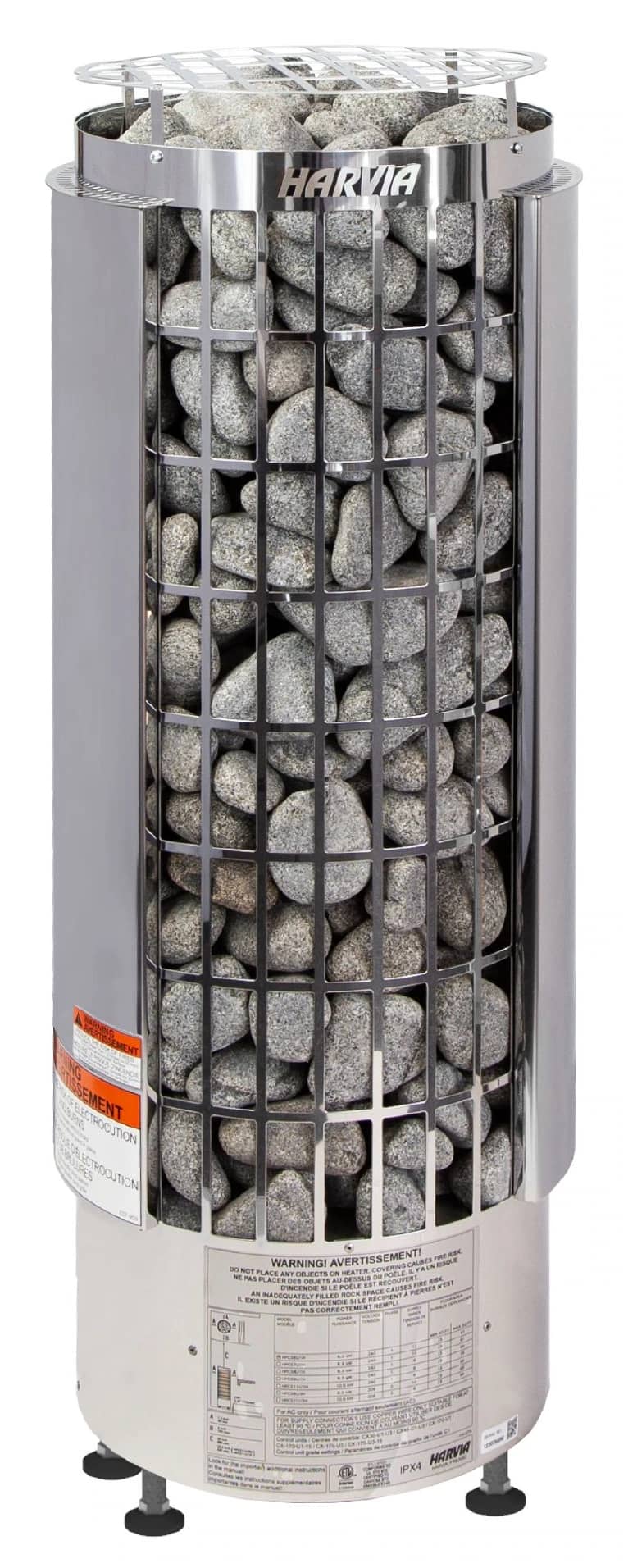
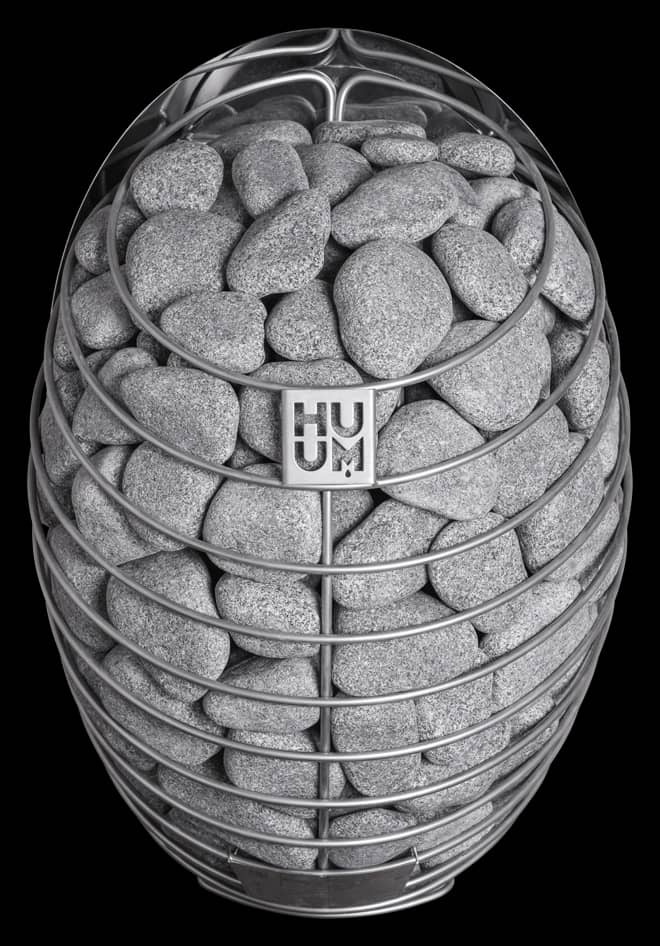
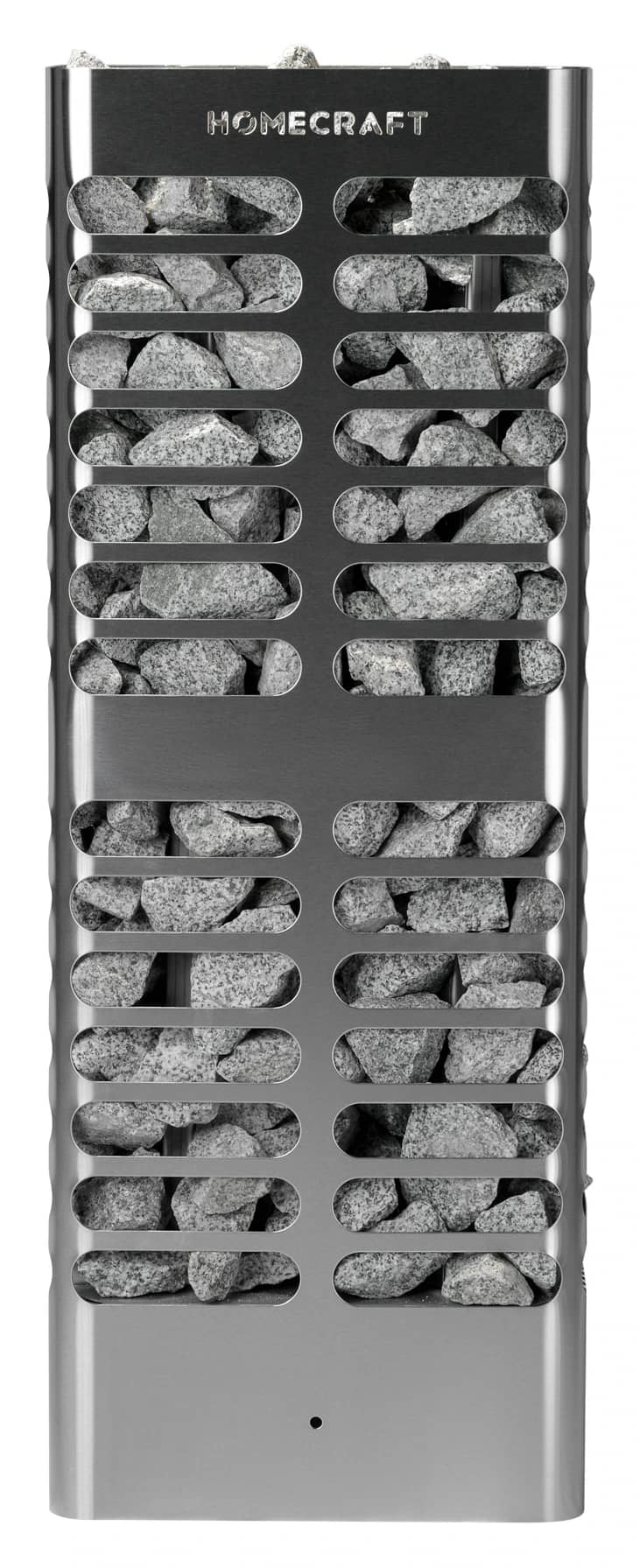
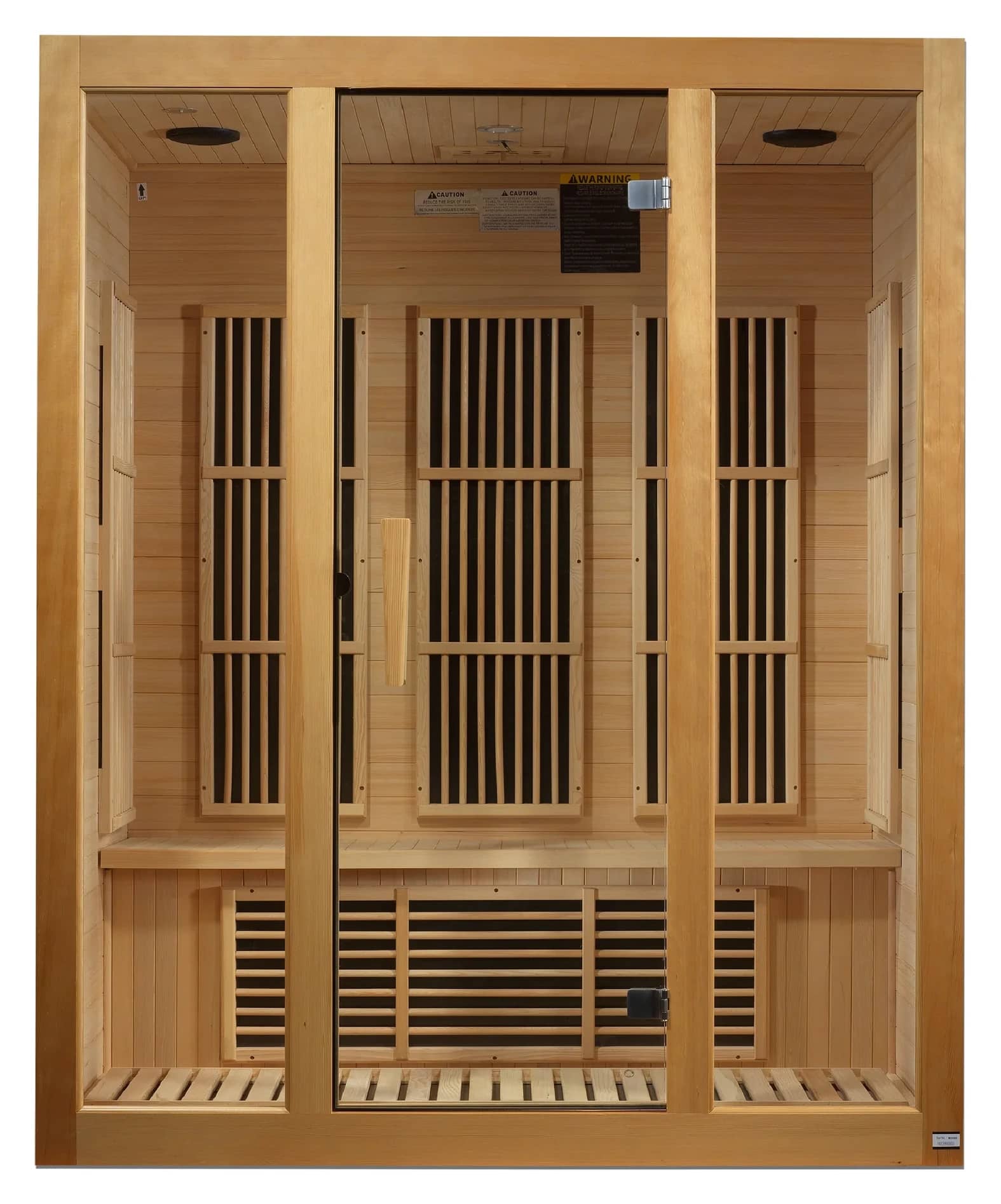
A traditional electric sauna heater needs its own circuit, sized from the heater's manual and wired by a licensed electrician. That circuit is 240 V for every heater we sell except the smallest: the 1.9 kW Harvia Vega Compact BC19, for rooms of 2–3 m³, also runs on 120 V (15.9 A), still hard-wired. A 6 kW heater draws 25 A and the manuals and the wiring chart we checked pair it with a 30 or 40 A breaker; a 9 kW heater draws 37.5 A and gets a 40 or 50 A breaker, depending on the source. A plug-in infrared sauna needs a dedicated 120 V circuit of 15 or 20 A instead. Every province we checked requires a permit, notification or declaration for new wiring, and Quebec requires a licensed contractor even in your own home.
The tables further down come from the heater and sauna manuals. Use them to plan and to check a quote; your electrician makes the final call for your panel, wire run and local code. Haven't chosen a heater yet? Start with what size sauna heater you need.
What a sauna heater needs
The manuals for the heaters we carry agree on the basics:
- A dedicated 240 V circuit with a two-pole breaker. Nothing else shares it.
- Heat-resistant copper wire. Harvia and HUUM give minimum sizes for 90 °C copper; HUUM asks for cable meeting CSA 49 in Canada; Homecraft asks for wire rated at least 105 °C at the heater (HUUM DROP manual; Revive Slim manual).
- A separate control unit. The Harvia Cilindro needs a CX30 or CX45 control (the CX45 at 8 kW and up on one circuit), the HUUM DROP a UKU control and the Homecraft Revive Slim a TKE2-2. The control is part of the electrical job.
- A permanent connection, no outlets in the sauna. Harvia calls for seal-tight conduit and no receptacles, plugs or pigtails in the sauna room (Harvia's North American Cilindro manual, Y05-0769). HUUM wants its junction box waterproof and no higher than 50 cm (19 11/16 in) above the floor.
- One heater per room, installed with the clearances on its nameplate.
- A permit or notification and an inspection. See the province-by-province section below.
What size breaker do I need for a sauna heater?
Current is simple arithmetic: watts divided by volts. A 6,000 W heater on 240 V draws 25 A; a 9,000 W heater draws 37.5 A. The breaker and wire sizes are where sources differ, which is why the first table below shows where each number comes from.
- Harvia's manuals give the current and the minimum wire size for 90 °C copper, but no breaker size. The Harvia breaker sizes in the table come from a published wiring chart, not from Harvia, which pairs each heater with a breaker and cable.
- HUUM's manual gives the breaker and wire for each DROP size (HUUM DROP manual).
- Homecraft's manuals give 30 A and 10 AWG for the 4 and 5 kW Revive Slim and 40 A and 8 AWG for the 6 kW (Revive Slim manual; TKE control manual).
Two things to notice. At 9 kW, that wiring chart lists a 40 A breaker for the Cilindro and a 50 A breaker for the Harvia Virta, although both draw 37.5 A; HUUM's manual also says 50 A for the DROP 9. And at 6 kW, HUUM says 30 A while Homecraft says 40 A. Both differences are reasons to let the electrician size the circuit from the heater you actually buy.
You'll also see a 125% rule quoted online. That comes from US guides written for the US National Electrical Code. Canada uses the Canadian Electrical Code, adopted by each province, and your electrician applies it.
208 V buildings and two-circuit wiring
Some buildings supply 208 V rather than 240 V. A heater built for 240 V gives less heat on 208 V: HUUM's manual lists the DROP 9 at 6.75 kW and 32.4 A on 208 V, with a 40 A breaker, and the DROP 6 at 4.5 kW (HUUM DROP manual). Harvia makes 208 V three-phase versions of some Cilindro and Virta sizes. Ask your electrician which supply you have before you choose a heater.
Harvia heaters can also be wired as two smaller circuits instead of one large one. The same wiring chart shows a 6 kW Cilindro on one 30 A circuit or on two 20 A circuits, and the control unit has to suit the layout (Harvia's Cilindro manual covers both).
GFCI: what the heater manuals say
A GFCI (ground-fault circuit interrupter) cuts power when current leaks to ground. It protects most wet-area outlets, but sauna heater makers advise against one on the heater circuit:
- Harvia: do not connect the heater through a GFCI (the manuals call it an RCD/GFI). (Harvia's North American Cilindro and Virta manuals).
- HUUM: recommends connecting the DROP without a GFCI breaker (HUUM DROP manual).
- Homecraft: don't use a GFCI breaker unless local code requires it (Revive Slim manual).
If your inspector says your installation needs GFCI protection, talk to the heater maker before you buy, so the warranty question is settled first.
Cold plunges are the opposite: Coldture says to plug the PRO Plunge into a GFCI-protected outlet, and its PRO Water Chiller has a GFCI built into the cord (PRO Plunge manual; PRO Water Chiller). Some infrared saunas go the other way again: the Maxxus Bellevue calls for a non-GFCI receptacle and breaker.
Infrared saunas: 120 V circuits
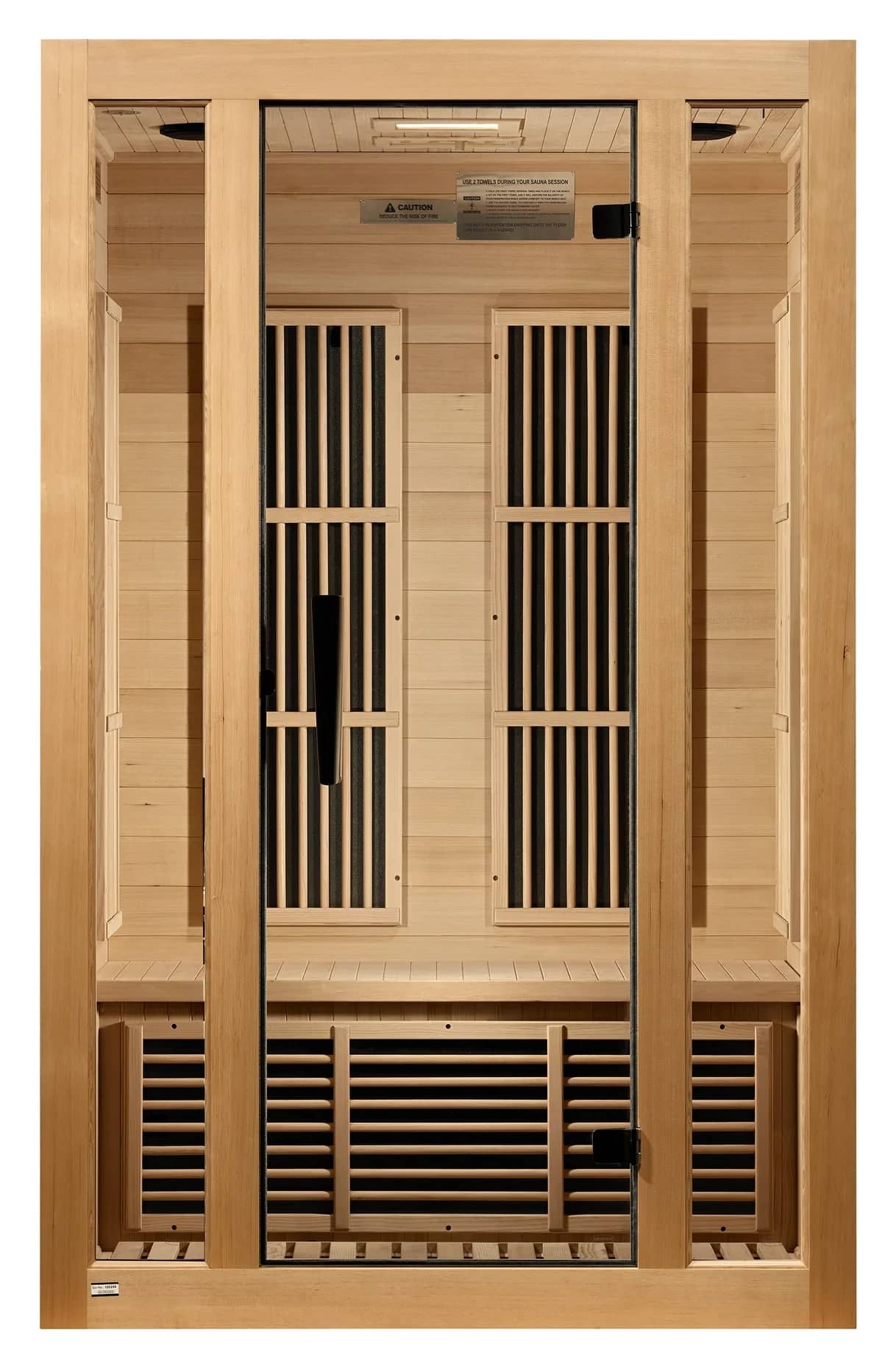
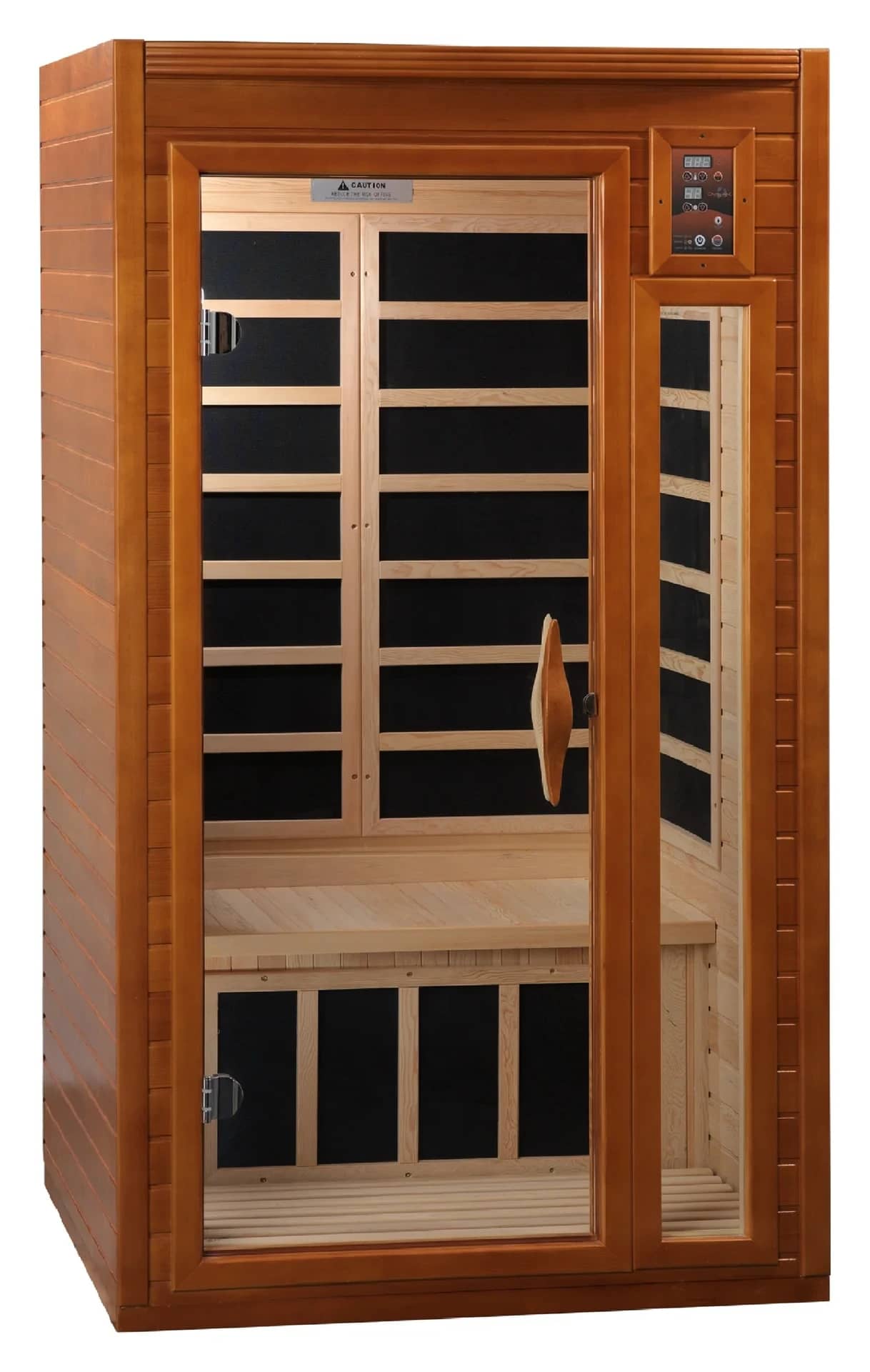
The infrared saunas we sell plug into a 120 V receptacle, but not just any receptacle. Their manuals call for a dedicated circuit: 15 A for the Dynamic Barcelona and the Maxxus Seattle, and 20 A for the 3-person Maxxus Bellevue (Barcelona manual; Seattle and Bellevue manual; Bellevue specifications).
- No extension cords, adapters or surge protectors between the sauna's cord and the wall (Maxxus manual).
- Check the receptacle before delivery day. If the room has no dedicated circuit, adding one is a job for an electrician and may need a permit like any other new circuit.
- Wattage isn't published by the maker for these three models, so we don't quote a figure.
Intertek's directory lists all three under their factories with the cETL mark to CAN/CSA-C22.2 No. 164, the Canadian standard for sauna rooms; check the mark on the unit's rating label when it arrives. Compare the two kinds in infrared vs traditional sauna or browse infrared saunas.
Cold plunges and chillers
Most cold plunge gear runs on ordinary 120 V power. Coldture rates the PRO Plunge at 12 A on a standard 15 A outlet, recommends a dedicated circuit, and says no extension cords; the PRO Water Chiller draws 8 A (PRO Plunge; PRO Water Chiller). Cedar tubs filled with ice need no power at all. Coldture notes that outdoor outlets must be GFCI-protected to code, so plan the outlet with your electrician. More in the cold plunge buying guide and our cold plunges.
Ontario's sauna heater rules, and why they exist
Ontario's Electrical Safety Authority (ESA) and the Office of the Fire Marshal report three deaths from sauna fires in ten years. They traced the fires to tampered or disconnected heat sensors, high-limit switches, timers and thermostats, unapproved replacement parts, heaters too close to combustibles, and towels or other combustibles left in the sauna (ESA Flash 25-20-FL).
The same notice sums up what Ontario's Electrical Safety Code asks of a sauna heater:
- It must be marked as suitable for a sauna and installed as its nameplate says, with the clearances kept.
- It must not sit below a shower head.
- It needs a timer that switches it off after no more than 1 hour, with no override; if the timer isn't part of the heater, it goes outside the sauna room and disconnects all the live conductors.
- Each enclosed area needs a temperature control, and nearby combustible surfaces must not get hotter than 90 °C.
Every electrical product used in Ontario must carry an approval mark that the ESA recognizes (ESA recognized marks). Look for a Canadian mark such as CSA, cUL, cULus or cETL on the label. A plain US UL mark is not Canadian approval.
Permits and inspections by province
Rules differ by province and sometimes by city. Here is what each authority says about new wiring at home; for a sauna heater circuit, assume you need a permit.
Ontario
Almost all electrical work needs a notification to the ESA (its word for a permit), filed by whoever does the work before it starts. Homeowners may do electrical work in their own home, but they must file the notification too. A building permit from your city is separate, and you may need both; see sauna permits in Canada. ESA inspects the rough-in and the finished work (ESA notifications).
British Columbia
Technical Safety BC issues electrical permits in most of the province. A homeowner permit is possible only for a single-phase service of 200 A or less, and not for a strata unit, a duplex or a home business (TSBC homeowner permits). Burnaby, Maple Ridge, North Vancouver, Surrey, Victoria, Vancouver and West Vancouver issue their own permits, so check with the city first (TSBC electrical permits).
Alberta
Calgary and Edmonton issue their own electrical permits under Alberta's Safety Codes Act. Both allow a homeowner permit only if you own and live in the home and do the work yourself; Edmonton doesn't offer one for condos, semi-detached or row housing (Edmonton). Calgary listed a homeowner electrical permit at $112 plus a 4% safety codes fee ($116.50) when we checked in November 2026, and says homeowners can't do their own load calculations (Calgary). Elsewhere in Alberta, ask your municipality who issues permits.
Saskatchewan
TSASK says a permit is needed for all electrical work at home. Homeowner permits are allowed, but hot tub, pool and service work needs a licensed journeyperson (TSASK).
Manitoba
Manitoba Hydro handles electrical permits outside Winnipeg; in Winnipeg, the City does. Owner-occupiers with a service of 200 A or less may do their own wiring, though Manitoba Hydro strongly recommends a licensed electrician, and hot tubs and pools need one (Manitoba Hydro).
Quebec
In Quebec, electrical installations must be done by a licensed electrical contractor, even in your own house (RBQ). The contractor declares the work to the Régie du bâtiment du Québec (RBQ declaration of work).
Other provinces and territories
We haven't summarized the Atlantic provinces or the territories yet. Ask your provincial or territorial electrical safety office before work starts.
Before the electrician comes
- Choose the heater first, then send the electrician its manual. The breaker, wire and control depend on the model, not just the kW. See the heater size guide and our sauna heaters.
- Ask about panel capacity. A 9 kW heater adds 37.5 A to a 240 V panel. Whether yours has room is a load calculation for the electrician.
- Basement install? Check the floor, moisture and venting too; see basement sauna.
- Measure the run. For an outdoor sauna, the distance from the panel affects the wire size and the cost. Get a quote with the route marked.
- Plan the control's spot. The manual says where the control and its temperature sensor go. In Ontario, a timer that isn't part of the heater goes outside the sauna room.
- Book the inspection. Keep the permit or notification number with your heater's paperwork.
Safety notes
- Use a licensed electrician. A sauna heater is a large, permanent load in a hot room, and the Harvia and HUUM manuals require a licensed installer.
- Never disable or bypass a high-limit switch, timer or thermostat, and replace parts only with approved ones.
- Keep towels and other combustibles out of the sauna when it isn't in use.
- Sauna heat isn't for everyone. Skip alcohol, and talk to your doctor first if you have a heart condition or another medical condition, or are pregnant.
Comparison tables
240 V sauna heaters: current, breaker and wire
Scroll the table sideways to see every column.
| Heater | Current | Breaker | Copper wire | Breaker source |
|---|---|---|---|---|
| Harvia Cilindro 6 kW | 25 A | 30 A | 10 AWG (manual minimum 12) | Published wiring chart (not from Harvia) |
| Harvia Cilindro 6.8 kW | 28.25 A | Not listed | 10 AWG minimum | None found |
| Harvia Cilindro 8 kW | 33.4 A | 40 A | 8 AWG | Published wiring chart (not from Harvia) |
| Harvia Cilindro 9 kW | 37.5 A | 40 A | 8 AWG | Published wiring chart (not from Harvia) |
| Harvia Virta 9 kW | 37.5 A | 50 A | 8 AWG | Published wiring chart (not from Harvia) |
| Harvia Cilindro 10.5 kW | 43.75 A | 60 A | 6 AWG | Published wiring chart (not from Harvia) |
| HUUM DROP 4 (4.5 kW) | 18.75 A | 30 A | 10 AWG | HUUM manual |
| HUUM DROP 6 (6 kW) | 25 A | 30 A | 10 AWG | HUUM manual |
| HUUM DROP 7 (7.5 kW) | 31.25 A | 40 A | 8 AWG | HUUM manual |
| HUUM DROP 9 (9 kW) | 37.5 A | 50 A | 8 AWG | HUUM manual |
| Homecraft Revive Slim 4 kW | 16.7 A | 30 A | 10 AWG | Homecraft manuals |
| Homecraft Revive Slim 5 kW | 20.8 A | 30 A | 10 AWG | Homecraft manuals |
| Homecraft Revive Slim 6 kW | 25 A | 40 A | 8 AWG | Homecraft manual |
Plug-in infrared saunas: 120 V circuits
Scroll the table sideways to see every column.
| Sauna | Circuit | Plug and outlet notes | Canadian listing (Intertek directory) |
|---|---|---|---|
| Dynamic Barcelona, 1–2 person | 120 V, 15 A dedicated | Plug-in, non-GFCI plug | cETL to CSA C22.2 No. 164, under the factory; check the label |
| Maxxus Seattle, 2 person | 120 V, 15 A dedicated | No adapter, surge protector or extension cord | cETL to CSA C22.2 No. 164, under the factory; check the label |
| Maxxus Bellevue, 3 person | 120 V, 20 A dedicated | Non-GFCI dedicated receptacle and breaker | cETL to CSA C22.2 No. 164, under the factory; check the label |
Questions
What size breaker do I need for a 6 kW sauna heater?
A 6 kW heater draws 25 A at 240 V. HUUM's manual and a published wiring chart for the Harvia Cilindro and Virta pair it with a 30 A two-pole breaker; Homecraft's manual says 40 A for its 6 kW Revive Slim. Your electrician sizes it from the manual of the heater you buy.
What size breaker do I need for an 8 or 9 kW sauna heater?
An 8 kW heater draws 33.4 A and a published wiring chart pairs the Harvia 8 kW with a 40 A breaker. A 9 kW heater draws 37.5 A: that chart lists 40 A for the Cilindro and 50 A for the Virta, and HUUM's manual says 50 A for the DROP 9.
What wire size does a sauna heater need?
From the manuals and a published wiring chart for Harvia heaters: 10 AWG copper on a 30 A breaker for most 4–6 kW heaters, 8 AWG for 7.5–9 kW (and Homecraft's 6 kW), and 6 AWG for Harvia's 10.5 kW. Harvia and HUUM specify 90 °C-rated copper; Homecraft wants wire rated at least 105 °C at the heater. Long runs may need heavier wire.
Does a sauna heater need a GFCI breaker?
The heater makers say no. Harvia says not to connect through a GFCI, HUUM recommends against one, and Homecraft says not to use one unless local code requires it. If your inspector requires GFCI protection, ask the heater maker about the warranty before you buy.
Can a sauna run on 120 V?
Yes, in two ways. The plug-in infrared saunas need a dedicated 120 V circuit: 15 A for the Dynamic Barcelona and Maxxus Seattle, 20 A for the Maxxus Bellevue. Among stone heaters, the 1.9 kW Harvia Vega Compact BC19 runs on 120 V at 15.9 A for rooms of 2–3 m³; it is hardwired, not plugged in. Our other stone heaters need 240 V.
Do I need a permit to wire a sauna in Ontario?
Yes. The ESA says almost all electrical work needs a notification filed before the work starts, by whoever does it, including a homeowner working on their own home. A building permit is separate (ESA).
Can I install a sauna heater myself?
Some provinces let owner-occupiers do their own wiring with a homeowner permit, but Quebec doesn't, and Harvia's and HUUM's manuals call for a licensed electrician. We recommend one in every province: it's a large load in a hot room, and the warranty and your insurance may depend on it.
How much current does a sauna heater draw?
Divide the watts by the voltage. At 240 V: 4.5 kW draws 18.75 A, 6 kW 25 A, 7.5 kW 31.25 A, 8 kW 33.4 A, 9 kW 37.5 A and 10.5 kW 43.75 A, as the Harvia and HUUM manuals list.
Shop sauna heaters & wood stoves
Sources
- ESA Flash 25-20-FL: sauna heater fires and code rules
- ESA: notifications and permits and recognized certification marks
- Technical Safety BC: homeowner electrical permits and electrical installation permits
- City of Edmonton: electrical permits
- City of Calgary: trades permits
- TSASK: electrical permits and inspections
- Manitoba Hydro: DIY wiring and permits
- RBQ: work you can do yourself and declaration of work
- Harvia Cilindro PC-E instructions (Y05-0769) and Virta HL instructions (Y05-0767), North American editions; Harvia Cilindro PC60E and Virta HL90E specifications
- HUUM DROP 2.0 user manual, US edition
- Homecraft Revive Slim installation manual and TKE control manual
- Dynamic Barcelona manual; Maxxus Seattle and Bellevue manual; Maxxus Bellevue specifications
- Coldture: PRO Plunge, PRO Plunge manual, PRO Water Chiller